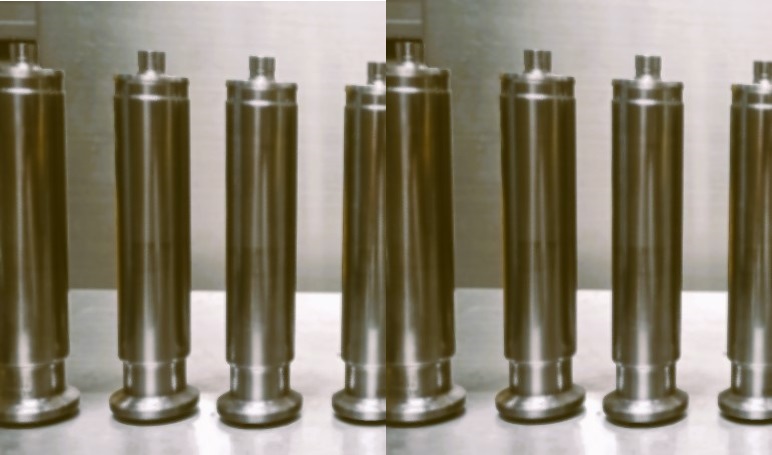
“What is tooling?” is one of the most common questions that many new pharmacists ask during their first year working in a pharmaceutical company. Although they learn about tablet manufacturing in college, many still don’t fully understand what tooling is. Having clear, basic understanding of tooling in tablet manufacturing is highly beneficial for problem-solving and continuous improvement on the production floor. This article begins by discussing the definition of tooling and how a tablet press works. It then describes basic terms related to tooling and the different types and sizes of tooling. After that, it describes important tooling measurements. Finally, we will explore the latest technology related to tooling in tablet manufacturing.
In tablet manufacturing, tooling consists of two punches – upper punch and lower punch – and a die, which together compress the powder into tablets in a tablet press. According to the Tableting Specification Manual (7th Ed.), the upper punch is the punch inserted into the turret above the die and lower punch is the punch inserted into the turret below the die. The turret is the main part of a tablet press that holds the tooling. Meanwhile, the die is the tool that serves as the mold where the powder is compressed to a determined tablet size and shape. Imagine a well: the lower punch acts as the bottom of the well, the die forms the wall of the well, and powder is poured in like water, filling the empty volume. The upper punch then compresses the powder from above, forming the tablet.
Before continuing the discussion about tooling, it’s helpful that we have a basic understanding of how a tablet press works. Modern tablet press used in tablet manufacturing is actually called rotary tablet press. It has a rotating body called a turret, composed of die table, which holds and aligns the tooling, and cam track, which guides the tooling through the tableting cycle. The tableting cycle includes several phases: powder is first filled into the die in filling phase, then its quantity is adjusted in the weight adjustment phase to match the target tablet weight, followed by compression into solid and compact form, and ends with ejection of the finished tablet.
Tablet press works on the principle of overfilling. It happens during the fill position and weight adjustment position in the tableting cycle. What do we overfill? The granule powder that we want to compress into tablets. Let’s say that we want to make 500 mg Acetaminophen tablets that weigh 600 mg each. As mentioned earlier, we fill the die cavity with powder during the fill position. However, we fill it more than the amount that we need to make a single tablet. After that, we scrape out the excess powder during the weight adjustment position and compress what’s left inside the die cavity to achieve the desired tablet weight in the compression position. Understanding how a tablet press works, the tableting cycle, and the principle of overfilling is important for smooth and effective communication between production personnel, especially when tableting problems arise during production.
Tooling components have specific names that make it easier to understand their roles in the compression process. A punch has three main parts: punch head, punch barrel and punch tip. The punch head is the end of the punch that guides it in the cam track through the tableting cycle. Punch barrel is the area between the punch head and the punch tip. Punch barrel stays in the punch guide of the tablet press turret. Punch tip is the end of the punch that meets the powder in the die. Punch tip determines the tablet size, shape, profile and identification. Meanwhile, the die has a die bore and a die groove. The die bore is the cavity where the tablet is compressed. Die groove is a grooved part of the outer perimeter of the die that helps secure it in the turret of the tablet press. Understanding these tooling terms will certainly facilitate communication between personnel on the production floor.
Tooling is designed in different types and sizes. This differentiation serves to ensure efficient manufacturing of high-quality tablets. Although tooling can be designed in many ways to optimize tablet production, there are two common sizes of tooling: B size and D size. D tooling is larger than B tooling. That also means that the maximum tablet dimension depends on these sizes. There are also two common types of tooling shape: the U.S. TSM and the European (EU) standard. The most noticeable difference between those two types is the punch head shape, or we call it the head profile. Another important distinction is the length of the punch. The TSM punches are 133.35 mm long, while the EU punches are 133.60 mm. We should pay attention to the differences between those types because a tablet press is built for a specific type of tooling. We cannot use TSM tooling on an EU tablet press, and vice versa. Forcing the use of tooling with an incompatible tablet press may damage both the tooling and the tablet press. Always make sure that your tooling is suitable for the tablet press you have.
| Size | Punch Barrel Diameter (mm) | Die Diameter (mm) | Maximum Tablet Diameter – Round (mm) | Maximum Tablet Diameter – Shaped (mm) |
| B | 19 | 30.16 | 16 | 19 |
| D | 25.4 | 38.1 | 25 | 25 |
The next important aspect to understand about tooling is its measurements. Tooling – particularly the punch – has three important measurements: overall length, cup depth, and working length. The overall length is defined as the length from the top of the punch head to the tip of the punch. The cup depth is the distance from the punch tip to the bottom of the cup. The cup is the cavity within the punch tip that determines the tablet form. Lastly, the working length is measured from the bottom of the cup to the top of the punch head. This is a critical measurement because it affects tablet weight and thickness. In fact, the working length of punches should be carefully maintained to avoid significant variations between them to ensure consistency in tablet weight and thickness.
Nowadays technology applied to solid dosage manufacturing has brought improvements to tooling to achieve more effective and efficient tablet manufacturing. Tooling manufacturers and tablet press designers are working hard to achieve this goal. One remarkable advancement is the die segments. Imagine several dies combined in one wide plate. For instance, on a 33-station tablet press, this replaces the need to install 33 individual dies with just 3 die segments, each segment holding 11 die bores. This significantly reduces the time required to prepare the machine for tablet production. Keeping up with the latest technological developments in pharmaceutical manufacturing is beneficial, especially when it comes to continuously improving our production processes.
Understanding the basics of tooling in tablet manufacturing is very beneficial in problem solving and continuous improvement on the production floor. Tooling definitions, basic principles of how a tablet press works, and types and sizes of tooling are essential knowledge in tablet manufacturing. It significantly supports clear communication between production personnel, and helps avoid confusion while discussing solutions to tableting problems on the production floor. Consequently, it will help the team to gradually improve the production process to be more effective and efficient.
References:
- American Pharmacists Association. (2006). Tableting Specification Manual (7th ed.).
 prastomowrites.com
Leave a comment